ACI MEMBERSHIP BENEFITS – Chance to save $12,000

Canadian Inventors Association now offers membership plans for everyone looking to expand their business and build potential connections. If you are an inventor, businessman, entrepreneur, or you want to market a product we are giving you the opportunity to do so for an incredibly minimal price and a great package.

Every package is curated keeping in mind all your needs and maximum benefits offered for you as our main goal is customer satisfaction and helping others promote their business in the best ways possible. We offer Regular, Premium, Business, and VIP Association of Canadian Inventors membership as follows. Each member will receive an ACI membership ID card, certificate.

Other Law agents or Patent attorneys charge about $40,000 to get your entire work done. However, at PatentK we only charge $12,000, and by having one of the membership plans you can SAVE even more! Assuming you have 2 patents ongoing, 3 OAs per patent, and all prosecutions finish within 2 years.

So Hurry Up & APPLY NOW!

After you applied:

1. We will review your application

2. We will approve applicants who meet the criterion and send them a membership e-mail

For more enquires contact + 1 647 863 9358 / +1 647 657 6686

We are looking forward to working with you!

Connect with us on

EELUME the ‘snake robot’ can fix pipelines on the ocean floor

The deep-sea oil and gas industry has a vast and costly infrastructure to maintain. Wells, other equipment, and thousands of kilometers of the pipeline must be installed, inspected, and repaired. Now, cutting-edge underwater drones and robots are being developed that could make the work safer, cheaper, and less polluting.

Among them is Eelume, a six-meter-long, snake-like robot kitted out with #sensors and a camera at each end. It can be kept at a docking station at depths up to 500 meters (547 yards) for six months, without being brought back to the surface. The self-propelling robot can travel up to 20 kilometers before needing to return to its station to recharge and can swap out parts for different tasks, including tools to operate subsea valves, and cleaning brushes to remove marine growth and sediments.

Maintenance work at many deep-water wells and pipeline systems is already carried out by unmanned vehicles. But these vehicles typically need to be transported to the offshore site on a fully crewed ship and then remotely operated from onboard the surface vessel. That can cost up to $100,000 per day, according to Pål Liljebäck, chief technology officer with Eelume Subsea Intervention, which developed the robot.

#Eelume can work autonomously on tasks assigned from a control room onshore, and send back video and data. Its snake-like design allows it to work in confined spaces and wriggle its body to stay in place in strong currents. By docking under the sea, it can be deployed whatever the conditions on the surface of the ocean.

Article by CNN Business

Subscribe to our newsletter for more interesting articles and updates

Apple files patent for ‘light-absorbing’ matt black finish for MacBooks

If you’ve always found Apple’s products too shiny, or insufficiently shadowy, you’ll be pleased by the company’s latest patent activity. A new patent application, , describes a new type of anodizing that can “absorb” light to make a matt black color look even darker,  reports. By etching small pores in the top layer, more light will be absorbed by the metal, giving a darker black that doesn’t reflect light.

The concept is in many ways reminiscent of the color #, which absorbs 99.965% of all light and is one of the darkest substances known to man.

Apple doesn’t specify in the patent that this would be used on a laptop, and indeed pictures of a phone, tablet, and smartwatch appear alongside a laptop in the related images. But the MacBook range is the most obvious application for such technology.

As usual, a patent application is not proof that a matt black MacBook is on the way – we wouldn’t, for example, bet money on such a color finish being offered for the new 14in MacBook Pro – but it certainly points us towards the development areas Apple currently finds interesting.

For more Patent application-related information check out our official page https://patentk.com/

Article by Macworld

The global rise of 3D printing during the COVID-19 pandemic

3D printing enables on-demand solutions for a wide spectrum of needs ranging from personal protection equipment to medical devices and isolation wards. This versatile technology is suited to address supply-demand imbalances caused by socio-economic trends and disruptions in supply chains.

The digital versatility and quick prototyping of 3D printing empowers a swift mobilization of the technology and hence a rapid response to emergencies. Even during severe
disruptions in supply chains, critical parts can be manufactured on-demand by any decentralized 3D-printing facility in the world by leveraging designs shared online. Moreover, the addictive nature of 3D printing enables product customization and complex designs. The broad spectrum of 3D-printing applications in the fight against COVID-19.

3D printing is also being used to provide training and visualization aids for healthcare workers to cope with the limited pool of trained personnel. Digitization will continue to transform 3D-printing machines into key parts of the Internet of Things and Industry 4.0 environments in the post-pandemic, cyber-physical age

By Nature Reviews

Follow, like and subscribe to our page for more information . https://patentk.com/

: https://twitter.com/PatentKofficial

: https://www.facebook.com/patentk

: https://www.instagram.com/patentk_services/

Facts About Patents:Everything you need to know

What Are some Interesting Facts About Patents?

Interesting facts about patents abound but while many people are familiar with the term, they do not know what a patent is and why someone needs it. Interesting facts cover a variety of issues such as why you should hire a patent attorney and when a patent expires. 

FAQS

Q. How long have patents been in existence?

A. Patents date back to the ancient Greeks. In 1474, the first patent law was put into effect in the Venetian Republic. 

Q. When was the first U.S. patent issued?

A. The first U.S. patent was assigned to Joseph Winslow in 1633.

Q. I have an invention, but some might feel it’s not useful or silly. Can I still get a patent?

A. Since patents have been issued, there have been inventions that are considered silly such as a bicycle with its own sail, a face-mask that prohibits the wearer from eating, even a shirt for gerbils. None of these inventions were disqualified for a patent. 

Q. I have an interesting invention for that could be used by major retailers. Should I approach the company directly?

A. Probably not. An example of what can happen dates to 1963 when a big box department store was approached by an individual offering the patent for their invention. The company rejected the invention noting it had no value but paid the individual $10,000 for the research. The company then proceeded to manufacture the invention that ultimately earned the business over $40 million in sales. 

Q. Is the polio vaccine patented?

A. No. Jonas Salk did not patent the vaccine. It’s estimated the worth of the vaccine would have netted Salk around $7 billion. 

Q. What about insulin? Was that patented?

A. No. The researchers involved in discovering insulin made the decision not to apply for a patent. They did this so the treatment of diabetes would remain inexpensive. 

Q. Did Benjamin Franklin patent his many inventions?

A. No. He felt it was important to give back to those whose inventions he had had access to and that anything he invented should be shared with the world.

Q. I realize there are a lot of questionable patents that make no sense. Is there one that stands out?

A. Yes. One that didn’t stand a chance was when the Halliburton Company attempted to get a patent for patenting.

Article by Upcounsel

Follow, like and share our page for more https://patentk.com/

: https://twitter.com/PatentKofficial

: https://www.facebook.com/patentk

: https://www.instagram.com/patentk_services/

The World’s First Rollable smartphone is coming in 2021

By CNET

LG’s tease of its Rollable smartphone at its CES 2021 press conference isn’t just for show. The Korean company will release the phone later this year, according to people familiar with LG’s plans. 

The brief glimpse of the phone was the second tease of the Rollable, which has a display that extends upward to create a larger, more tablet-like screen. Presumably, the bottom of the phone, when it’s in landscape mode, has a mechanism that furls and unfurls the display, similar to how its rollable OLED televisions work — but on a smaller scale. 

The LG Rollable only showed up in two videos bookending the press conference and the executives on stage didn’t mention the device. That led to speculation that it was only a concept device, not ready for prime time. TCL later Monday showed off two concepts for rollable phones, including a larger 17-inch tablet that unfurled from both ends, like a treasure map, but those appear to be far away from an actual product.

LG Rollable is the rollable smartphone from LG and could be the first commercially available rollable smartphone. Oppo has also showcased the rollable smartphone but it’s a concept and LG Rollable looks like will be a mass-produced device that people can actually buy. LG could unveil the LG Rollable in March 2021

Robotic guide dogs

By Science Focus, 2020

A student at Loughborough University has designed a “robotic guide dog” that will help support visually impaired people who are unable to house a real animal.

The product, designed by Anthony Camu, replicates the functions of a guide dog as well as programming quick and safe routes to destinations using real-time data.

Theia, named after the titan goddess of sight, is a portable and concealable handheld device that guides users through outdoor environments and large indoor spaces with very little input.

Using a special control moment gyroscope (CMG), Theia moves users’ hands and physically “leads” them – much like holding the brace of a guide dog.

The device is designed to process real-time online data, such as traffic density (pedestrians and cars) and weather, to guide users accurately and safely to their destinations.

It will have a fail-safe procedure for high-risk scenarios, such as crossing busy roads – pushing the user back into a “manual mode”, similar to using a cane.

Tactile virtual reality – Make VR easy to access

by  12th August 2020 in Science Focus

Researchers from Northwestern University have developed a prototype device that aims to put touch within VR’s reach, using a flexible material fitted with tiny vibrating components that can be attached to the skin.

The system, known as epidermal VR, could be useful in other cases as well, from a child touching a display relaying the gesture to a family member located elsewhere, to helping people with amputations renew their sense of touch.

In gaming, it could alert players when a strike occurs on the corresponding body part of the game character.

The team’s design features 32 vibrating actuators on a thin 15cm by 15cm silicone polymer which sticks on to the skin without tape or straps and is free of large batteries and wires.

It uses near-field communication (NFC) technology – which is used in many smartphones for mobile payment today – to transfer the data.

“The result is a thin, lightweight system that can be worn and used without constraint indefinitely,” says Professor John A Rogers, who worked on the project.

Scientists hope that the technology could eventually find its way into clothing, allowing people with prosthetics to wear VR shirts that communicate touch through their fingertips.

The bicycle wheel that “purifies” the air while it is in motion

by Alessio Iannicelli15 October 2020 in EnvironmentLifePrototypes 

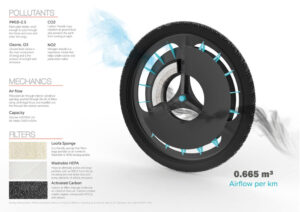
Kristin Tapping – a student of industrial design at London South Bank University – has created a bicycle wheel with a filter to purify the air.

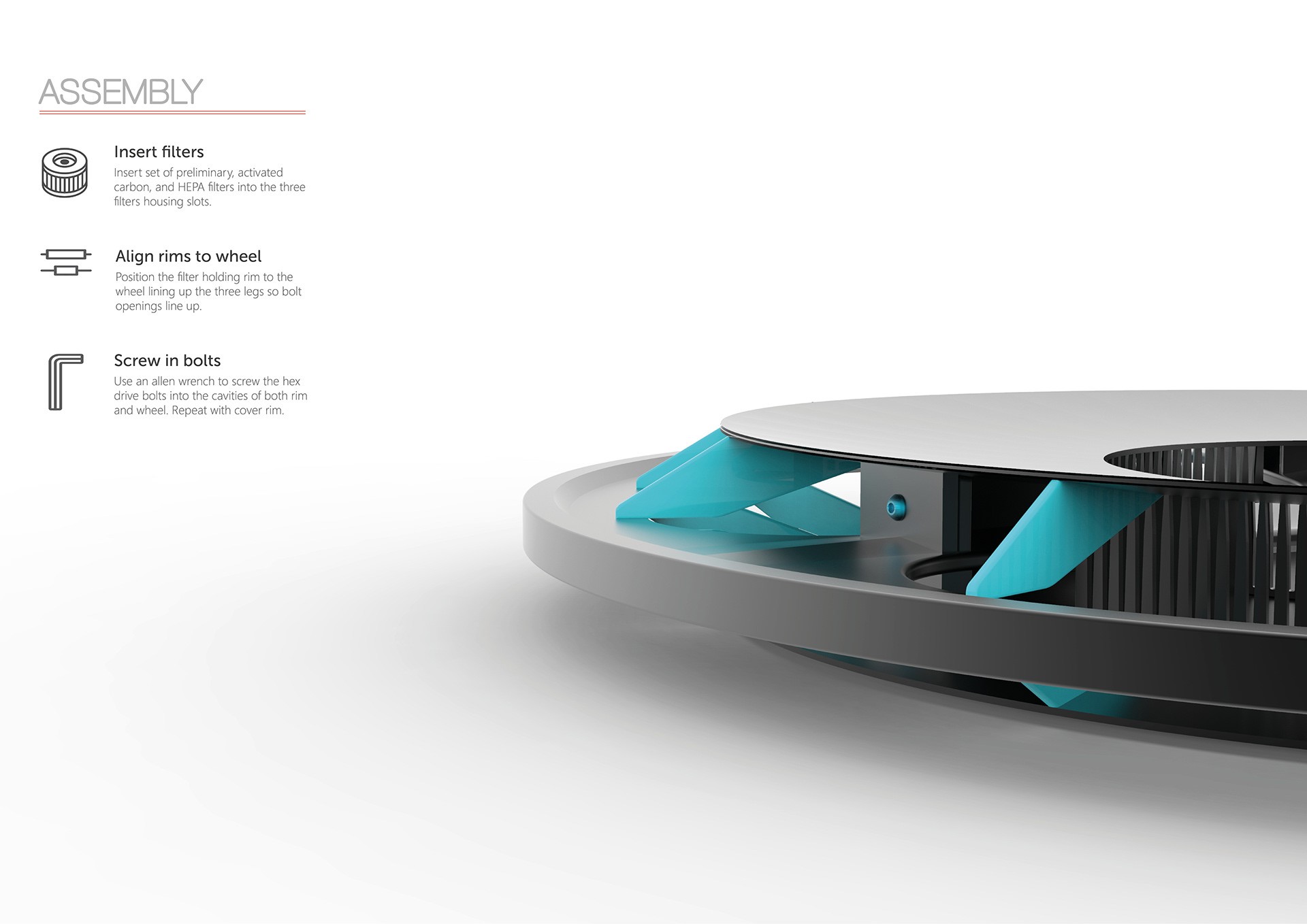
Is there a more ecological vehicle than a bicycle? Yes, a bicycle that “purifies” the air! It sounds absurd but it’s all true. Kristin Tapping – an industrial design student at London South Bank University – has created a bicycle wheel with a filter inside to purify the air. The project is called Rolloe and won the prestigious “Design Innovation in Plastics 2020” award. The idea behind it is simple but at the same time (potentially) ingenious. The wheel measures 600x600x60 mm and weighs just over a kilo. Inside, there is a filtering system consisting of three sponges. The first retains large particles, the second blocks pollen and dust while the third (with active carbon) traps gas molecules. In this way, the filter also removes volatile organic compounds. The filters can be dismantled, washed and reused. Kristin recommends replacing them once a week or after 250 kilometres.

Read also → Designed for cycling with ABS

The bicycle wheel that purifies the air

When the bike is in motion, air enters the wheel through a circular opening, passes through the filter and comes out purified. To facilitate the passage of air, there are also aerodynamic external fins. Kristin Tapping had the idea for Rolloe as she cycled through the streets of London. “I could see and smell the pollution from the tyres and exhaust pipes. I thought: why not use the movement of the vehicles to filter the air?”. The name Rolloe stands for Roll Off Emissions because it could have a strong environmental impact. According to a study conducted by the Design Innovation in Plastics 2020 commission, if 10% of London’s bicycles were equipped with this special wheel, about 266,865 m³ of air could be filtered every day. This value could double if bicycles were also equipped with Rolloe for the rear wheel.